

A Quiet Ride Before Sunrise
At 4:30 in the morning, the city is still asleep. Fewer motorbikes. A cooler breeze moving through the quiet intersections. The street lights still glowing softly.
I wake up slowly, make a small breakfast, and sip water while my body wakes up. Today’s training session starts at 6 a.m. at Van Phuc City, which means the day begins much earlier than that.
Fifteen kilometers of cycling just to get to the training location.
Some people might see that as inconvenient. For me, it feels like part of the ritual.
The quiet ride before sunrise has become one of my favorite parts of endurance training.
The city gradually wakes up as I pedal across bridges and empty roads. My legs loosen up, my breathing settles, and the mind becomes calm.
That morning ride is where the day really begins.
And on this Sunday, after a week of intense sessions, I felt something unusual.
A quiet sense of pride.
Not excitement. Not relief.
Just a deep feeling that the work is happening.
The Week That Tested Everything
This past week was one of the toughest training weeks I’ve had in a long time.
Not because of a single workout. But because of the accumulation.
Endurance training has a way of layering fatigue slowly. Each session feels manageable on its own, but together they ask something deeper from you.
On Tuesday and Thursday mornings, I cycled 40 kilometers on Ba Son Bridge. Those sessions are designed to simulate hills and build strength in the legs.
The bridge climbs are repetitive and relentless. Up, down, repeat.
In the afternoons, I joined swimming sessions with Coach Khoa. Each session was around 1600 meters, focusing on technique and endurance.
Then came the running sessions.
Wednesday pushed me hard with an 18 kilometer tempo run. One of those workouts where the body questions your decisions halfway through.
Friday followed with a 15 kilometer easy run. Still long, still demanding.
After work on both days, I went straight to strength training.
Not glamorous workouts. Just slow, controlled exercises to build durability.
And on Saturday came the brick workout.
Forty kilometers of cycling on Ba Son Bridge followed immediately by a four kilometer tempo run.
Brick sessions are never easy.
Your legs feel confused when you start running. They still think you are on the bike.
But brick workouts are an important part of triathlon training. They teach your body to transition between sports when fatigue is already present.
By Sunday morning, my body felt tired.
But strangely, my mind felt stronger.
That is the quiet magic of endurance training.

The Power of a Training Community
Sunday’s session was special because it was my first time training with the Zoot team since the Bau Trang training camp.
We gathered at Van Phuc City, about twenty athletes in total.
The session was led by Captain Phuong, someone I deeply respect.
I have not known her for very long. But even from the first time I met her, I could feel a powerful presence.
Some people simply carry strong energy.
Phuong is one of them.
She has been vegetarian for twenty two years, originally because of her love for animals. Over time she also began studying nutrition and understanding how a vegetarian diet could support her body.
What amazes me is that she has completed multiple full Ironman races while maintaining this lifestyle.
Ironman preparation demands enormous physical energy. Seeing someone do it with such conviction and joy is inspiring.
But what I admire most about Phuong is her spirit.
She is always cheerful.
The kind of person who brings energy into a group without trying.
And in endurance sports, that kind of energy matters more than we often realize.
Training can be lonely. Many sessions happen early in the morning or late after work.
Having a training community changes everything.
On Sunday, two of Phuong’s friends came to support the session.
They brought bananas, watermelon, water, electrolytes, and ice.
While we ran, they watched over our bikes.
Small acts of kindness like that create an atmosphere that feels special.
It reminds you that endurance sports may be individual races, but the journey is never truly solo.

The Van Phuc City Training Session
Van Phuc City surprised me.
The entire area is about 180 hectares and sits on an island near the river.
Wide roads curve through residential areas with lakes and green spaces. The air feels noticeably cooler than other parts of the city.
Compared to Saigon Hi-Tech Park where I often train, the difference is striking.
Here, the roads are smooth.
There are very few vehicles.
Most people you see are runners or cyclists.
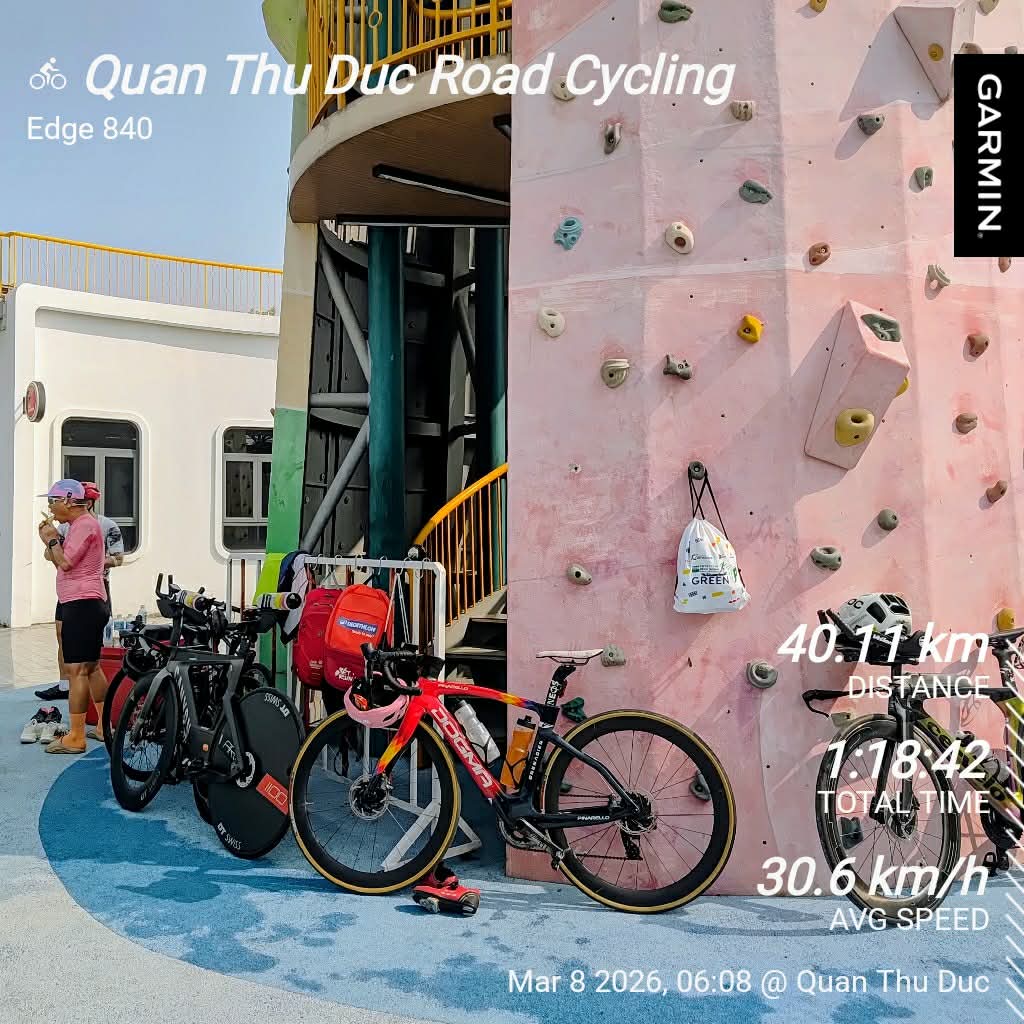
Our cycling route consisted of loops of roughly 4.8 kilometers each.
For me, the session was six loops, totaling about 40 kilometers.
The rhythm of loop training is strangely calming.
You pass the same turns again and again.
The same trees. The same quiet houses. The same stretch of road near the river where the wind brushes across the water.
After cycling, we switched to running.
Ten kilometers around the same loop.
The legs were heavy at first.
But gradually they found their rhythm.
Running after cycling always feels like teaching your body a new language.
For a moment, everything feels awkward.
Then suddenly it clicks.
Your stride settles. Your breathing evens out.
And you remember why you love this sport.
What Real Discipline Actually Looks Like
When people hear about endurance training, they often imagine motivation.
Big goals. Exciting races. Dramatic moments of victory.
But the reality is much quieter.
Real training discipline looks like this:
-
waking up at 4:30 a.m.
-
cycling 15 kilometers just to reach the training session
-
completing an 18 kilometer tempo run midweek
-
returning after work for strength training
-
repeating bridge climbs again and again
There is nothing glamorous about it.
Just consistent effort.
Week after week.
Session after session.
Motivation is temporary.
It comes and goes depending on mood, weather, and life circumstances.
Discipline is different.
Discipline shows up even when motivation is absent.
And the beautiful thing about endurance training is that discipline slowly builds confidence.
Not loud confidence.
But quiet confidence.
The kind that whispers, you’ve done the work.
The Invisible Team Behind the Training
Another truth about endurance sports is that success is rarely individual.
Behind every athlete is an invisible support system.
For me, that support has been incredibly important in recent weeks.
My coaches guide the structure of my triathlon training and help adjust sessions when the workload increases.
Nutrition has also become a focus.
Some sessions require more carbohydrates for recovery. Others require balanced protein intake to support muscle repair.
Learning how to fuel the body properly is just as important as the workouts themselves.
Recovery has been another key factor.
I see my physiotherapist, Dung, twice a week.
And my massage therapist, Hoan, also helps release muscle tension and prevent injuries.
These sessions might seem small.
But they allow the body to absorb the training instead of simply accumulating fatigue.
When people talk about Ironman preparation, they often focus on mileage.
But recovery and nutrition are equally important parts of the equation.
Without them, the body cannot sustain the workload required for endurance performance.
Two Weeks Before Race Day
Today is March 8.
The race will take place on March 29.
That means there are roughly two weeks of intense training left before tapering begins.
Tapering is the phase when training volume gradually decreases so the body can recover and peak for race day.
Right now, we are still in the hardest part of the program.
Next week will likely be another demanding week.
Then the volume will begin to drop.
Standing there after Sunday’s training session, I realized something.
I feel stronger than I did a few weeks ago.
Not just physically.
Mentally.
There is a certain calm that comes from knowing you are following a plan.
Trusting the process becomes easier when you see the small improvements accumulating.
Endurance training teaches patience.
Progress rarely appears in dramatic breakthroughs.
Instead, it arrives quietly.
One stronger session.
One better recovery.
One more week completed.

Finishing the Week
After the run, we gathered briefly near the bikes.
Some people stretched.
Others shared fruit and water.
The morning sun had fully risen by then, warming the roads that had been cool just hours earlier.
My body felt tired.
But it was a good kind of tired.
The kind that comes from honest effort.
As I cycled the 15 kilometers back home, I thought about how far this journey has already come.
There are still two weeks before the race.
More sessions ahead. More fatigue. More preparation.
But something inside feels ready.
Not because everything is perfect.
But because the work has been done consistently.
And that is the quiet power of endurance training.
It teaches us that preparation is rarely dramatic.
It happens through small decisions repeated every day.
Wake up early.
Train with intention.
Take care of the body.
Support others in the community.
Then slowly, almost without noticing, you become stronger than you were before.
And one morning, after a long week of training, you realize something simple.
You are ready.
